Why Big PC Manufacturers Are Moving Away from Windows 11
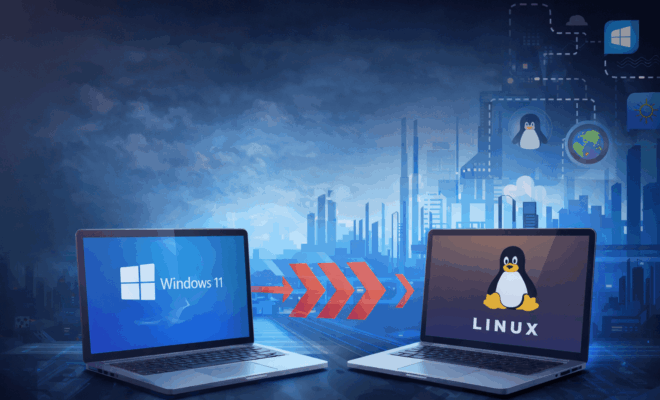
“This article explores how rising costs and strict Windows 11 system requirements are driving PC manufacturers toward operating system alternatives. It analyzes the shift toward Linux based laptops and cost reduction strategies as the industry enters the Great Decoupling of 2026.”
The Technology landscape of 2026 is witnessing a historic pivot. For nearly three decades, the personal computing industry followed a rigid script written by two players: Microsoft and Intel. This Wintel partnership wasn’t just a business arrangement; it was the law of the land. If you bought a laptop from Dell, HP, or Lenovo, you were essentially buying a vehicle for Windows. However, as we move through 2026, that script is being shredded.
Hardware giants are slowly but firmly leaving Windows. Economic need, hardware frustration, and a strategic desire to maintain profit margins in a volatile market drove this decision. The Great Decoupling is transforming your desk device.
The Hardware Tax: When Requirements Become Roadblocks
The cracks in the foundation appeared when Microsoft drew a hard line in the sand regarding Windows 11 system requirements. By mandating TPM 2.0 and specific CPU generations, they didn’t just upgrade a piece of software; they effectively declared millions of perfectly functional PCs obsolete.
By 2026, this Hardware Tax will become even more restrictive. To keep pace with Microsoft’s obsession with AI PCs and the Copilot+ suite, a laptop now requires a dedicated NPU (Neural Processing Unit) and a baseline of 16GB of RAM just to maintain a fluid user experience. For a manufacturer, this is a logistical nightmare. It is no longer viable to build a high quality, $350 everyman laptop when the operating system demands premium tier internals just to run the desktop environment without lagging.
Manufacturers are exhausted of software updates dictating product roadmaps. OEMs must handle unsold inventory and pacify customers whose two year old devices are suddenly unsupported by the latest features when Microsoft raises the hardware requirement.
The Economic Breakup: Strategies for Survival
The global economy of 2026 has not been kind to hardware vendors. With AI data centers consuming the lion’s share of the world’s semiconductor supply, the cost of DRAM and NAND storage remains stubbornly high. When an operating system requires 16GB of RAM as a bare minimum, it erodes the profit margin of every mid range device produced.
This is where cost reduction strategies become vital. Every Windows machine shipped carries a per unit licensing fee paid to Microsoft. By exploring operating system alternatives, manufacturers can remove that fee from their balance sheets. This allows them to either pass those savings to the consumer or retain them to offset rising component costs.
By pivoting to lightweight, efficient alternatives, brands like ASUS or Acer can market a machine with 8GB of RAM that actually outperforms a bloated Windows 11 machine with 16GB. In a market where every dollar counts, being Windows free is transitioning from a niche technical choice to a competitive advantage.
The Linux Glow Up: From Hobbyist to Mainstream
One of the most legitimate surprises of 2026 is how Linux based laptops have moved from enthusiast forums into mainstream retail. This is not the clunky, command line heavy Linux of a decade ago. Modern distributions are sleek, high performance, and incredibly stable.
Much of this shift can be attributed to the Steam Deck Effect. When Valve proved that a Linux based OS could handle high end gaming with more efficiency than Windows, the hardware industry took notice. Now, Lenovo and Dell are not just offering Linux; they are optimizing for it. They have realized that Linux offers true hardware agnosticism. They can build a laptop, tune the kernel perfectly to that specific screen and battery, and ship a product that works seamlessly without waiting for Microsoft to resolve a buggy driver update.
The Cloud Shift: The Diminishing Role of Local Software
The way we work has also altered the value proposition of a local operating system. In 2026, the vast majority of computing tasks will happen within a browser. Whether it is Google Workspace, Slack, or enterprise web applications, the heavy computational lifting is performed on a remote server rather than on the local processor.
This evolution has allowed manufacturers to focus on Thin Clients. If the local OS is merely a gateway to the web, the Windows Tax becomes redundant. We are seeing a surge in devices that run minimal, proprietary shells or browser based systems. These machines are cheaper to manufacture, boast superior battery life, and do not require the massive, intrusive security patches that frequently plague Windows 11.
In this new landscape, the hardware brand the quality of the chassis, the keyboard feel, and the display matter more than the software logo. The operating system has finally become a background detail.
Consumer Backlash: Bloat, Ads, and Privacy
Finally, the shift is being driven by user sentiment. By 2026, consumer fatigue regarding Windows 11 has reached a tipping point. The OS has become increasingly cluttered with bloatware, integrated advertising in the search bar, and invasive features like Recall, which indexes user activity for AI training.
Enterprise IT departments are hitting a breaking point as well. Managing a fleet of Windows devices is a grueling cycle of dodging forced updates and troubleshooting compatibility issues. Many organizations are now seeking operating system alternatives that offer greater administrative control and less background data transmission. Users want a reliable tool, not a data harvesting platform, and manufacturers are reading the room.
Conclusion
Windows is not disappearing; it will likely remain the primary choice for high end creative professionals and hardcore gamers for the foreseeable future. However, the era of Windows being the default choice for every form factor is coming to an end.
The Great Decoupling represents the maturation of the PC market. It grants manufacturers the freedom to innovate on their own terms and provides consumers with a market defined by hardware quality rather than software monopolies. The era of the one size fits all computer is over, and the era of specialized, efficient, and diverse devices has finally arrived.